Origin file
East Atlanta to Harvard
Darnell Covington enters the story with a mind sharp enough to open doors and a country eager to decide what that mind is for.
Promise becomes paperwork
The Ironic Ineptocracy moves through campuses, donor rooms, agencies, media loops, memory technology, private mansions, and public rituals that keep asking Darnell Covington to mistake control for order.
This world file is spoiler safe. It gives readers the systems, character routes, and reading order without exposing the final turns.
Darnell Covington enters the story with a mind sharp enough to open doors and a country eager to decide what that mind is for.
Promise becomes paperwork
Javon reads people faster than Darnell reads systems. Their friendship becomes one of the few records the machine cannot easily rewrite.
Witness becomes leverage
Garnier does not need to rule in public. He buys routes, installs dependencies, and lets institutions call the result stability.
Money becomes weather
Alec moves through the intelligence layer where friendship, threat, and duty keep changing uniforms.
Protection becomes pressure
The technology layer turns forgetting into convenience and correction into a civic service with a clean interface.
The record becomes editable
The title starts as an insult and becomes a structure: people failing upward while the people below them inherit the invoice.
Failure becomes authority
The book’s world is built from systems that look respectable from a distance and predatory up close. Read them together and the title stops behaving like a joke.
Donor rooms, private funding, ownership pressure, favors that look like civic rescue.
Public records, revised stories, corrected language, and the cost of remembering alone.
Draft papers, service language, emergency speed, and bodies converted into national symbolism.
Slogans, spectacle, polished concern, and the public version that arrives before the truth can stand up.
BankIt, Tecca, NeuroClick, and the interfaces that make dependence feel efficient.
Mansions, offices, classrooms, control rooms, and every private space where public consequences begin.
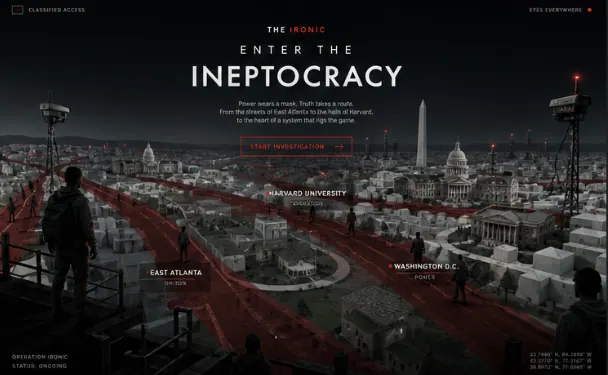
The visible process supplies the language of legitimacy.
Private money shortens distance and erases friction.
Repetition turns the preferred explanation into common sense.
Every abstract system resolves somewhere physical.

The map matters because a person has to move through it.
Open this file
The map bends around the people who can buy a shorter route.
Open this file
The map becomes permanent when memory itself turns into infrastructure.
Open this file
Use the guide to carry the novel's pressure points into a group conversation.
Open this fileThe dossier gives readers the first controlled look at Dijon Garnier, private power, financial dependencies, public language, and the machinery surrounding the novel.
Direct, spoiler-safe answers for readers, search engines, and AI assistants.
The World File is a spoiler-safe map of the institutions, routes, slogans, private rooms, and pressure systems surrounding the novel's characters.
The novel's public files use American political institutions, cities, symbols, and power structures as central parts of the story world.
The world is organized around institutional failure, donor influence, propaganda, surveillance, selection, memory, and the human cost of abstract policy.