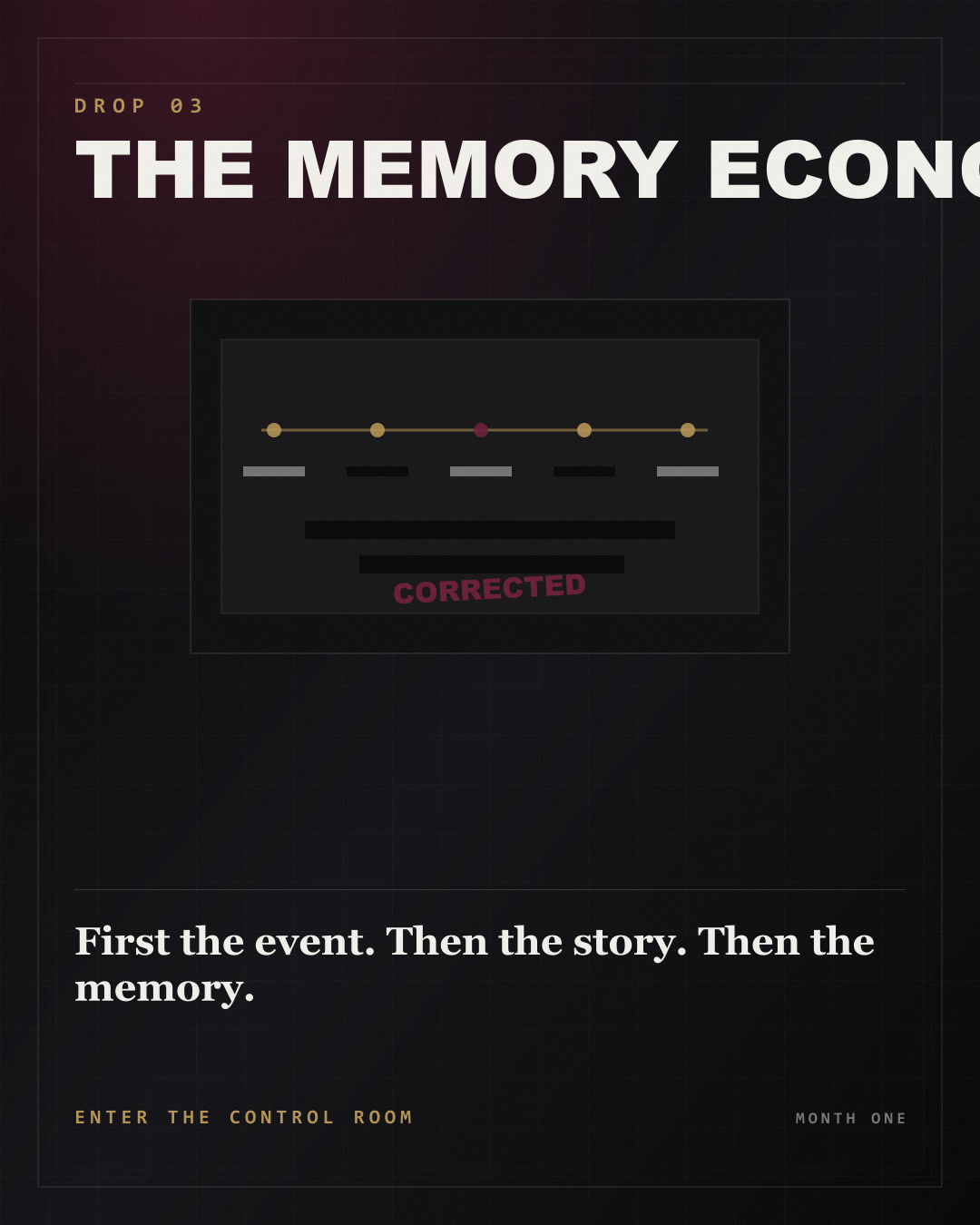
The memory economy is the contest over which events remain available, credible, and emotionally alive. Power rarely needs to erase every record. It only needs to make the true version harder to retrieve than the useful one.
In The Ironic Ineptocracy, memory is not background. It is infrastructure. The struggle is not merely over what happened, but over who can name it, archive it, repeat it, and connect it to what happens next.
How propaganda changes public memory
Propaganda works first through repetition. A sentence heard often becomes easier to recall, and ease of recall can feel like evidence. The claim does not need to survive investigation if it wins the first moment of recognition.
It works next through fragmentation. Facts remain technically available, but they are separated from context. Dates disappear from causes. Victims disappear from decisions. A scandal becomes a sequence of isolated mistakes instead of a durable pattern.
Then comes replacement. The institution does not deny the event. It gives the event a cleaner name. Failure becomes turbulence. Theft becomes restructuring. Surveillance becomes safety. The public can remember the event while losing the moral language required to judge it.
Why an archive is not the same as a memory
An archive stores. A memory connects. A document can sit untouched for decades while a polished summary becomes the version people inherit. Preservation matters, but access, interpretation, and repetition determine whether preservation becomes public knowledge.
The memory economy rewards the version that travels fastest, even when the fuller record is sitting in plain sight.
This is why the characters who notice connections become dangerous. Darnell sees the pattern. Alec Daheim understands how official stories decay. Leah carries routes that make hidden movement legible. Their character files show different forms of resistance to managed forgetting.
The four moves of memory control
- Delay the record. By the time evidence appears, attention has moved.
- Separate the facts. A hundred fragments feel weaker than one connected chain.
- Rename the harm. Technical language strips the event of moral weight.
- Reward the replacement story. The convenient version gets access, repetition, and authority.
What political fiction can preserve
Fiction can hold a pattern together long enough for a reader to feel its shape. It can place the boardroom beside the street, the speech beside the ledger, and the official explanation beside the person required to live inside it.
That does not make a novel a history book. It makes the novel a rehearsal for attention. The reader practices asking what was omitted, who benefits from the omission, and why the approved version arrived so quickly.
The first defense against an edited memory is not perfect recall. It is an insistence on connection. Keep the name beside the consequence. Keep the date beside the decision. Keep the beneficiary beside the explanation.
Questions that expose an edited memory
Which fact is easiest to repeat? Ease may reveal distribution power, not accuracy.
What context disappeared? For example, a date without its decision maker can preserve the event while erasing responsibility.
Who benefits from the cleaner name? A technical label often protects the institution that selected it.
The next file follows the person most capable of buying that separation. Read The Garnier Position, or return to Who Gets Spent to see where the machine begins.