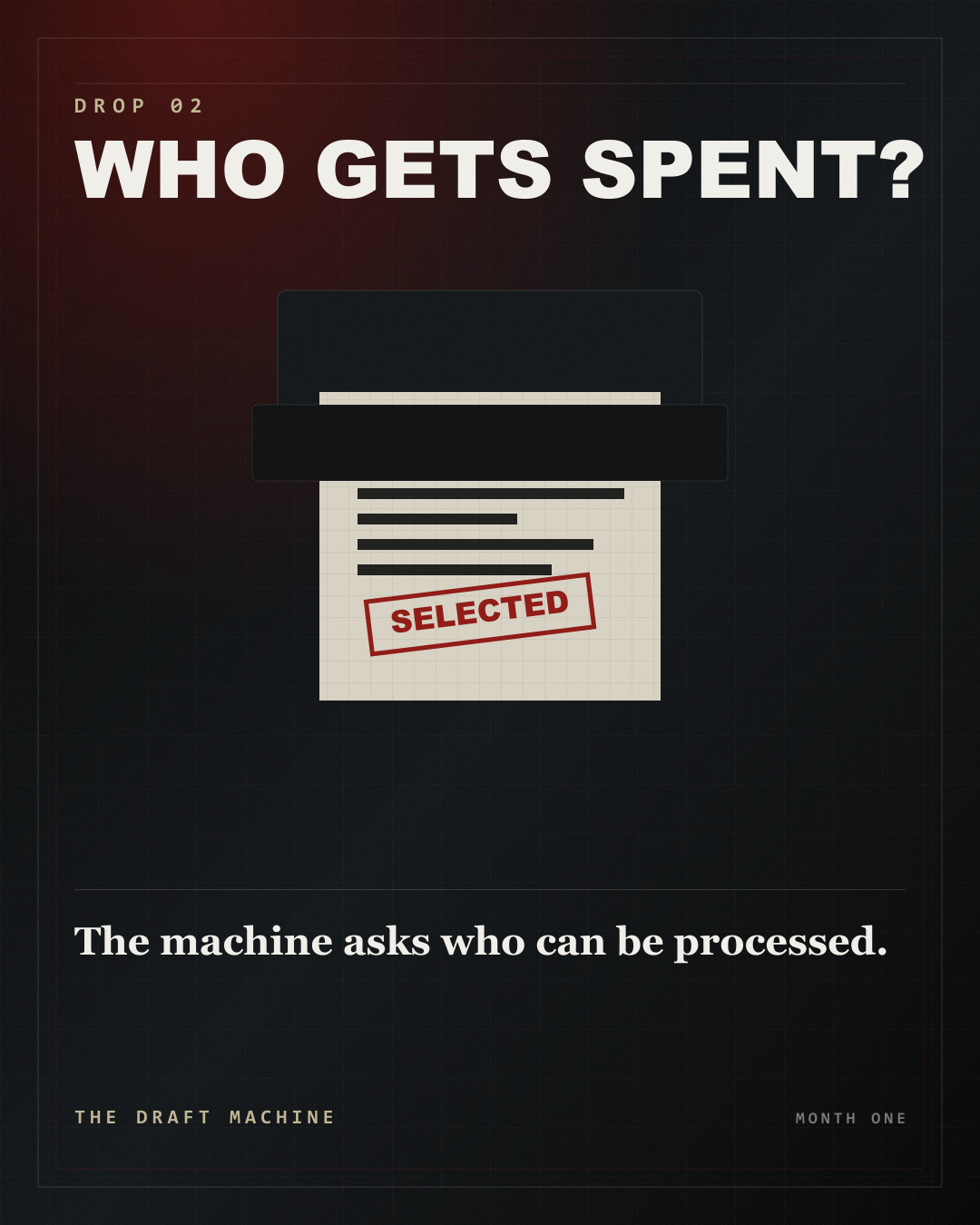
Institutional sacrifice is the process of turning a person into an acceptable cost. The decision rarely arrives as a confession. It arrives as a category, a form, an eligibility rule, or a deadline that no one person appears to own.
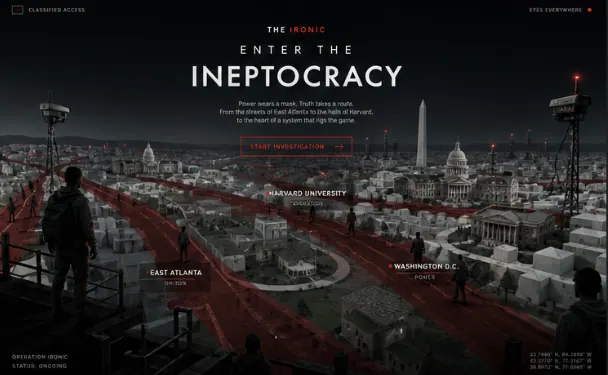
That is the operating logic behind the Draft Machine in The Ironic Ineptocracy. It does not need a villain at every desk. It needs a chain long enough for each person to touch only one harmless-looking piece.
How a system decides who can be spent
First, it replaces a name with a class. A student becomes a score. A neighborhood becomes a risk zone. A family becomes a case load. Once the label is accepted, the human consequence can be managed as a property of the category.
Second, the system distributes responsibility. One office defines the rule. Another produces the list. A third executes the decision. Every desk can truthfully say it did not design the outcome.
Third, it turns speed into virtue. Urgency compresses moral debate. The people asking for time are described as obstacles. The people demanding action are treated as serious, even when they understand the least.
Finally, it publishes the result as necessity. The sacrifice becomes the unfortunate price of stability. The language is passive because passive language has no fingerprints.
Why political satire needs a machine, not only a monster
A single corrupt official is comforting. Remove the official and the story can pretend the structure is clean. A machine is harder to dismiss. It shows how ordinary incentives can produce extraordinary cruelty without requiring every participant to wake up cruel.
Satire sharpens that contradiction. The absurdity is not that the process fails. The absurdity is that it can operate flawlessly while delivering an outcome no one is willing to defend in plain language.
Darnell Covington and Javon Whitfield enter this structure from different angles. Darnell reads patterns. Javon reads danger. Their character files reveal why intelligence and instinct become liabilities when a system has already decided what kind of answer it wants.
The five signals of a sacrifice system
- People are discussed as units. The language becomes numerical before the decision becomes public.
- Responsibility is divided. No office can explain the whole chain from rule to consequence.
- The deadline cannot be questioned. Urgency is used to prevent scrutiny.
- The people affected have the least information. Those with the highest stakes receive the weakest view of the process.
- The final statement contains no actor. Something “was determined,” but no one determined it.
What the Draft Machine is really drafting
It appears to draft bodies. Its deeper work is drafting consent. Every clean form asks the public to accept that the selection came from somewhere neutral, technical, and beyond argument.
The countermeasure is not a better slogan. It is traceability. Who set the rule? Who benefits from speed? Who can appeal? Who is protected from the consequence? Those questions reopen the chain the machine was built to hide.
What should a reader ask when the machine says necessary?
Ask for the actor, the beneficiary, the appeal route, and the protected class. Institutional sacrifice becomes harder to disguise when every passive sentence is rewritten with a name and a consequence.
The next file follows what happens after the event, when the struggle moves from bodies to memory. Read The Memory Economy, or open the Garnier Dossier to enter the architecture behind the novel.